

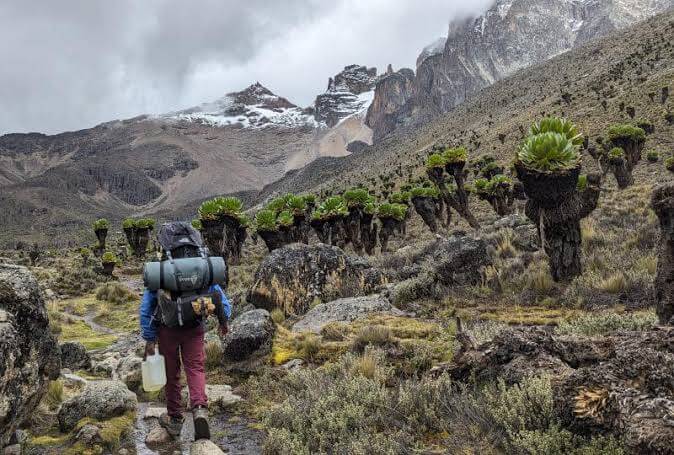
Mount Kenya National Park
Guide to Mount Kenya National Park 2027: Facts | Kenya Safaris
Straddling the Equator Mount Kenya National Park is an absolute powerhouse of a destination that deserves a top spot on any ultimate Kenya safari itinerary. Located in Kenya’s Central Circuit of Kenya, about 175 km Northeast of Nairobi, this sprawling 715 sq. km park cuts across the beautiful counties of Kirinyaga, Nyeri, Meru, and Tharaka-Nithi.
Whereas it anchors the Eastern section of the Rift Valley circuit, its true draw is its towering and jagged topography.
Mount Kenya National Park was officially declared a National Park in 1949. It was upgraded from a forest reserve. In 1978, it was declared a UNESCO Biosphere Reserve, and in 1997, it was crowned a UNESCO World Heritage Site. This park takes its name from the scenic Mount Kenya, which features over 12 remnant glaciers.
Mount Kenya National Park extends up to 2800 sq. km. The park’s landscape features mainly the scenic Mount Kenya, also Africa’s 2nd highest peak (5199m). It is the most preferred destination for mountaineering adventures. Lush forests, alpine rivers, and scenic mountain slopes define the park’s extraordinary landscape.
Attractions in Mount Kenya National Park
Mount Kenya National Park features diverse tourist attractions. The main attractions to explore on a safari in Mount Kenya National Park include wildlife, birds, and Mt. Kenya.
Wildlife or Animals in Mount Kenya National Park
Mt. Kenya National Park holds a diversity of wildlife that survives within its alpine forest. The abundant wildlife to explore in this park includes leopards, elephants, cape buffaloes, sykes monkeys, lions, spotted hyenas, giant forest hogs, white-tailed mongooses, and bushbucks.
Additional wildlife that survives in Mount Kenya National Park includes the endangered mountain bongo, elands, black-fronted duikers, zebras, Sunni buck, bush pigs, olive baboons, and tree or rock hyraxes.
The birds of Mount Kenya National Park
About 160 bird species reside in the diverse habitats of Mt. Kenya National Park. The park accounts for 6 of the 8 endemic species to Kenya’s mountains. It also shelters over 50% of the Afro-tropical highland biome species.
The birds present in Mt. Kenya National Park include Abbott’s starling, hartlaub’s turacos, scarlet-tufted malachite sunbird, long-tailed widowbird, purple-throated cuckoos, African crowned eagles, green Ibis, and lesser kestrel.
The park also supports Abyssinian ground thrush, Jackson’s spurfowl, lammergeyers, red-fronted parrots, African crowned eagles, tambourine dove, African emerald cuckoos, montane nightjars, little grebe, red-billed ducks, African harrier-hawks, western cattle egrets, and Rameron pigeon.
A birding safari in Mount Kenya National Park can also reward you with sightings of cardinal woodpeckers, moustached tinkerbirds, pied kingfisher, fine-banded woodpeckers, brown-hooded kingfishers, African barbets, green-backed honey guide, cape crow, Sulphur-breasted bush shrike, and black-fronted bush-shrike.
Mt. Kenya
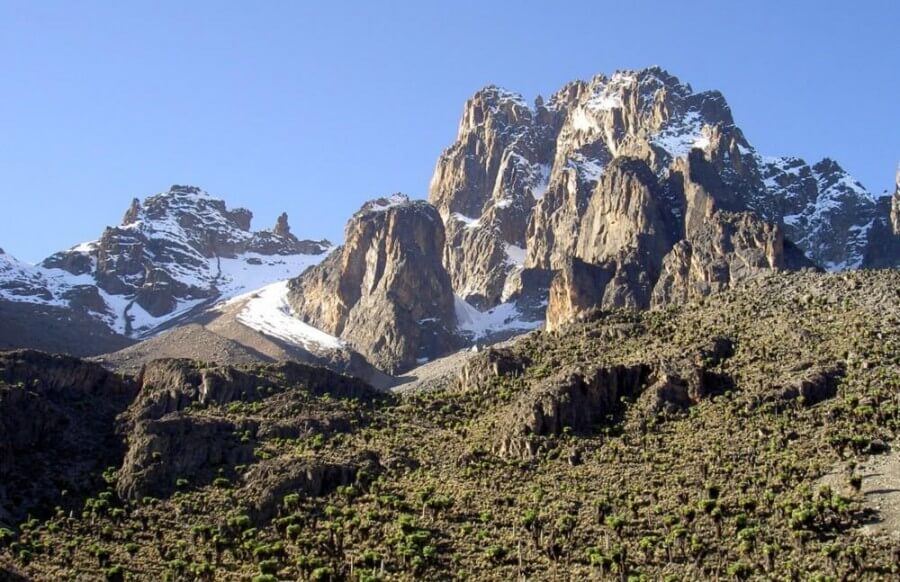
Mount Kenya is a unique feature that attracts many adventure seekers to conquer its great heights. Known to be an equatorial mountain, Mt. Kenya is snow-capped, with peaks having glaciers. It rises at an altitude of 5199m, creating a frigid alpine zone crowned with permanent ice and remaining glaciers.
The main peaks that make up Mt. Kenya include Batian (5199m), Nelion (5188 m), & Point Lenana (4985 m).
Mount Kenya formed about 3 million years ago. Mt. Kenya is ice-capped, although it has encountered glacial erosion on the slopes, creating valleys that radiate from the peak. About 11 small glaciers exist in Mt. Kenya, but they are melting rapidly.
At the base of Mount Kenya, there are different vegetation zones such as the alpine zone, semi-arid savanna, sparse wooded plains, and bamboo. Expect to also come across the rock hyrax, huge lobelias, and senecio subspecies.
Things to do in Mount Kenya National Park
Mount Climbing
Mount Kenya is an excellent mountaineering destination in East Africa. Adventure seekers have a chance to conquer up to 3 peaks, each offering climbers amazing trekking experience. Lenana (4985m) is the easiest peak to reach of the 3 peaks on Mount Kenya. Experienced climbers can consider exploring Batian and Nelion.
Climbers can follow the Naro Moru trail that leads to Point Lenana. The hikes begin from the hamlet of Naro Moru along the Western slopes of Mt. Kenya and continue to Mackinder’s camp.
The trail joins the peak circuit path, about 10km encircling Batian and Nelion peaks. The dry months are the best for you to enjoy the guided hikes on Mount Kenya. The dry months on the Kenyan calendar extend from June to October & December to March.
Game Viewing
Guided game viewing is another safari highlight when it comes to Mt Kenya National Park tours. Visitors get a chance to search for the amazing wildlife that survives in the different habitats, including zebras, black rhinos, buffaloes, and duikers.
Bird watching
Mt. Kenya National Park is ecologically rich with abundant birdlife. It is an incredible spot to identify birds such as the black-throated wattle eye, mountain yellow warblers, yellow-crowned bishop, Abyssinian crimson wings, brown-hooded kingfishers, and black-crowned tchagra.
Cave Tours
Mt. Kenya National Park is one of the best places adventure seekers can embark on cave exploration. Expect to experience the mix of the park’s rich history and explore the Mau Mau and alpine Shipton’s caves. The Mau-Mau caves are situated near Nanyuki, and is ideal for day treks. You need about 4 to 6 hours to complete the hike through the Mau Mau cave trail. The Shipton’s Cave is accessible on the Sirimon route and comes with scenic alpine scenery. The Sirimon route takes you up to 4367m.
Packing for a Safari to Mount Kenya National Park
Packing the right gear and items is essential when it comes to Mt. Kenya National Park safaris. The essentials to have include a waterproof rain jacket, insect repellents, a daypack, a first aid kit, thick socks, a camera, strong gloves, energy snacks, toiletries, a safari hat, and more.
When to Visit Mount Kenya National Park
The dry season offers excellent weather conditions for travelers to explore Mt. Kenya National Park. The dry months fall around June, July, August, September, October, December, January, February, and March. Heavy rains begin in November, April, and May. Adventures like mountaineering become challenging to engage in during the wet or rainy seasons/months.
Accommodation/Where to Stay
The main places to stay on a safari in Mount Kenya National Park include Penguin House, Soames Hotel, Serena Mountain Lodge, Castle Forest Lodge, and Hotel Fairmont Mount Kenya Safari Club.
How to Get to Mount Kenya National Park
Mount Kenya National Park can be reached in 175 km from Nairobi city. A 4×4 safari vehicle is ideal for road travel to Kenya National Park.
The access routes include the Nanyuki-Isiolo route through the Sirimon track. You can also drive on the Nyeri-Nanyuki route, which is near Naro Moru.
By air, you can reach Kenya National Park on a flight. You can connect by flight from Wilson Airport to Nanyuki Airfield, about 35 minutes.