

Ruaha National Park
Ruaha National Park Guide, Location, Lodges | Tanzania Safaris
Discover the ultimate guide to Ruaha National Park, one of the biggest and most biodiverse conservation areas.
The present Ruaha National Park started as Saba Game Reserve under the German Colonial Administration.
In 1946, it was renamed the Rungwa Game Reserve under British administration. It was declared a National Park in 1964.
By 2008, Ruaha’s land area extended to the Usangu Game Reserve, thus expanding it to currently 20,226 sq. km.
Where is Ruaha National Park Located?
The picturesque Ruaha National Park is 130 km West of Iringa & South of Serengeti. This park lies in South-Central Tanzania and forms the extensive Rungwa-Kizigo-Muhesi ecosystem.
It derives its name from the scenic Ruaha River, a natural river that flows on its Southeastern boundary.
Ruaha National Park is not crowded like Serengeti making it one of the best game viewing destinations.
Majority of wildlife in Ruaha National Park congregate around the Great Ruaha River.
The best time to visit the park is during the peak dry season when 1000s of wildlife converge along the few water sources.
Attractions in Ruaha National Park
Wildlife and birdlife make up the top list of attractions to explore in Ruaha National Park.
The diverse wildlife in Ruaha resides in the open savannahs, woodland, and baobab vegetation.
Others survive within the Ruaha River, especially aquatic species.
Wildlife
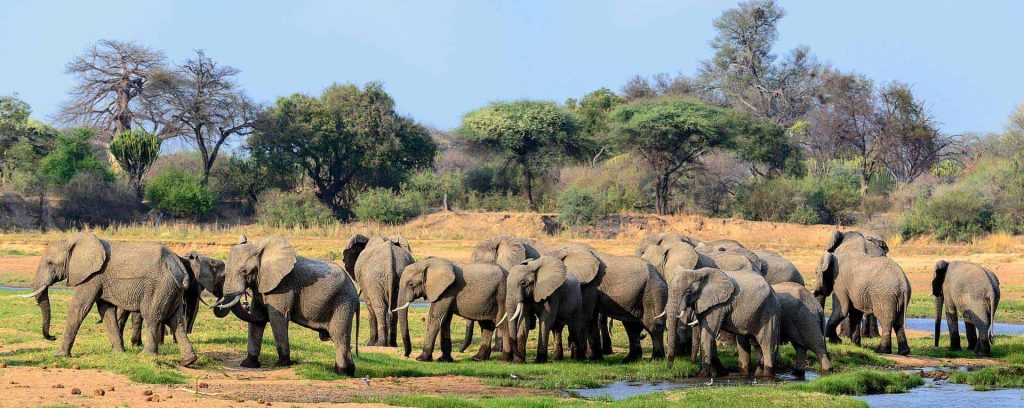
Ruaha National Park is home to about 10,000 elephants, plus a range of antelopes and other plains game species.
The plains game animals to find on a Tanzania safari in Ruaha include the zebras, Masai giraffes, waterbucks, impalas, and buffaloes.
The Bird species
Estimated population of 570 bird species have been recorded in the Ruaha National Park alone.
The different birds in Ruaha include knob-billed ducks. fulvous whistling-ducks. white-faced whistling ducks, blue-billed teal. African black ducks, Eastern crested guineafowl, helmeted guineafowl, coqui francolins, and scaly spurfowl.
Hildebrandt’s spurfowl, red-winged francolins, Shelley’s francolins, ring-necked doves, tambourine dove, laughing doves, Namaqua doves, dusky turtle doves, mourning collared-doves, and African green pigeon.
Purple-crested turacos, gray-go-away bird, Schawlow’s turacos, Senegal coucals, barred long-tailed cuckoos, lesser cuckoos;
Klaas’s cuckoos, pied cuckoos, great spotted cuckoos, Burchell’s coucals, and Dideric cuckoos.
Safari Activities in Ruaha National Park
Game drives
Ruaha National Park is most famous for game drives. Guided game drives through Ruaha offer a unique opportunity for travelers to explore diverse wildlife.
During Ruaha game drive, expect to find wildlife such as cheetahs, giraffes, sable antelopes, Kudus, buffaloes, lions, leopards, roan antelopes, zebras, and African elephants.
The game viewing session also lets you search for predator species and learn more about their behaviors.
Ruaha’s game drive is all about immersing yourself in the wilderness while spotting your favorite animals.
Birding Experience
If you love bird watching and planning your next safari in Tanzania, then a visit to Ruaha is worth it.
The park has a record of about 570 species of birds, which can be explored during a guided birding tour.
Ruaha National Park features mainly endemics, raptors, vibrant feeders, and water & river species of birds.
The bird checklist to expect to explore on a birding safari in Ruaha includes the red-chested cuckoos, Jacobin cuckoos, coppery-tailed coucals, barefaced go-away-birds, purple-crested turacos.
Senegal coucals, Diederick cuckoos, Levaillant’s cuckoos, Allen’s gallinule, lesser moorhens, African crakes;
Common cuckoos, white-browed coucals, Klaas’s cuckoos, black-bellied bustards, and Great spotted cuckoos.
Abdim’s storks, yellow-billed storks, African open-bill, Madagascar pond herons, cattle egrets, dwarf bittern, pink-backed pelicans, rufous-bellied herons, glossy ibis;
African sacred ibis, long-tailed cormorants, common ringed plovers, spotted thick-knee, three-banded plovers, and crowned lapwings, etc.
Additional bird species to explore include little stint, African jacanas, greater painted-snipe;
Great snipe, African scops owls, pearl-spotted owlets, mountain buzzards, black kite, African fish eagles, and Eurasian buzzards.
Other birds of birders’ interest include the pale-billed hornbills, blue-napped mouse birds, Pel’s fishing owls, red-billed hornbills, Southern ground hornbills, and Verreaux’s eagle owls.
Ruaha National Game Park also supports various birds, including Wahlberg’s honeybirds, Nubian woodpeckers, scaly-throated honeyguides, green-backed woodpeckers, and Bennett’s woodpeckers.
Little bee-eaters, lilac-breasted rollers, European bee-eaters, olive bee-eaters, Northern carmine bee-eaters, blue-breasted bee-eaters.
Giant kingfishers, brown-hooded kingfishers, African pygmy kingfishers, pied kingfishers, striped kingfishers, and red-footed falcons.
In the varied avifaunal habitats, there reside birds such as Chinspot batis, black cuckooshrikes. Black-throated wattle-eye, orange-breasted bush-shrikes, black-crowned tchagra, and grey-headed bush-shrike.
Hot air balloon experience
Fly high in the sky and enjoy amazing sightings of Ruaha National Park.
Above the breathtaking landscapes, expect to observe the meandering river courses, granite outcrops, baobabs, and acacia woodlands.
A range of wildlife can also be spotted as they begin early morning hunting, while large mammals like elephants can be watched while they head towards the river banks.
The round hot balloon excursion above the plains and diverse vegetation of Ruaha National Park is expected to last for an hour or 2.
The balloon experience can come with a spice of bush breakfast.
Guided walking experiences
Walking safaris offer a rare opportunity for you to connect deeper with nature.
Ruaha is one of the best destinations to visit to experience the most of bush walk excursions.
With bush walks, you get to explore hidden spots that can’t be reached while on a game drive.
Imagine walking along the baobab trees, along the riverbanks, while listening to melodious birds as they sing.
During a guided nature walk, you can be led by a professional ranger guide from Ruaha National Park.
A complete bush walk in Ruaha can last for about 2 hours while you search for birds, wildlife, and other species.
Community tours
Visit the nearby community and spice up your Tanzania safari experience in Ruaha. The Hehe villages surround the scenic Ruaha National Park. Expect to have hands-on activities, especially traditional beadwork, pottery making, and food preparation.
Best time to visit Ruaha Game Park
June to October mark the peak dry season and are the best time to enjoy guided game drives.
August to September are the peak months in Ruaha, while November to April are considered the green season/wet months.
It is during the wet months when tourists can explore several migratory species of birds.
The short dry months fall around January to February, and they come with crowds due to high visitor turnout.
Accommodation in Ruaha
On Tanzania safaris in Ruaha, expect to have an overnight stay at the Ruaha River Lodge. Saadani Safari Lodge.
Jabali Ridge. Jabali Private House. Charlie Ruaha Safari Camp, and Ikuka Safari Camp, etc.
Getting to Ruaha Game Park
By road –Drive from Iringa, and in about 3 to 4 hours, you can be at Ruaha National Game Park.
Setting off from Dar es Salaam can take you about 9-12 hours (625km), and from Arusha, expect to drive for about 10 hours.
By air –With flights, expect to have a quick connection to Ruaha from Arusha or Serengeti National Park.
The ideal landing points at Ruaha include Msembe Airstrip and Jongomero Airstrip.
3 Days Ruaha Wildlife Safari
Day 1: Fly to Ruaha –Enjoy the First Game Drive
- Pick up at the hotel in Dar es Salaam and set off on a domestic flight to Jongomero/Msembe Airstrip.
- Following early arrival, expect to be transferred to the lodge for lunch before you proceed with an afternoon game drive.
Day 2: Game drive through Ruaha, Full day
- Enjoy a long game drive through Ruaha National Park.
Day 3: Bush Walk & depart by flight
- Fly back home.